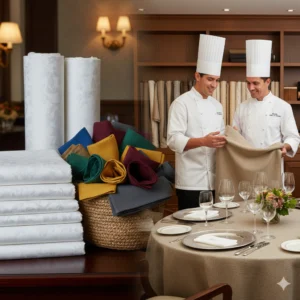
If you run a restaurant, hotel dining room, private club, or event venue in New York City, table linen is not a decoration — it’s operational infrastructure. It affects your housekeeping workflow, your laundry costs, and the first thing a seated guest touches before the first course arrives. This guide covers everything a restaurant owner or operations manager needs to know before choosing a table linen service in NYC: what’s actually available, how the rental model works, what drives cost, why Italian cotton keeps coming up in every conversation about fine dining presentation, and whether renting even beats buying in the first place.
What Types of Table Linen Are Actually Available
“Table linen” covers more ground than most first-time buyers expect. A restaurant table linen service typically supplies four categories, each with real material and sizing decisions behind it.
Tablecloths: Three Materials, Three Different Jobs
Commercial tablecloths come in three main materials, and picking the wrong one for your operation type is the most common mistake new accounts make:
- Italian cotton — long-staple fiber, traditionally combed, with a noticeably better drape and hand-feel than synthetic alternatives. This is the standard for fine dining, private clubs, and boutique hotels where the table presentation is part of what the guest is paying for. It’s also laundered separately from polyester inventory to preserve brightness. If you want the deeper technical breakdown of why Italian cotton behaves differently on the table, see our full comparison of Italian cotton versus standard commercial linen.
- Spun polyester — the commercial workhorse. More stain-resistant, cheaper to replace, and it holds its shape through far more wash cycles than cotton. This is the right call for casual dining, catering, and high-turnover banquet operations where durability matters more than hand-feel.
- Satin — reserved for event and gala presentations that need a high-sheen finish. Most commonly seen at corporate awards dinners, wedding receptions, and luxury event venues where the aesthetic itself is part of the deliverable.
Standard sizing runs rounds (60″, 72″, 90″) and rectangles (60″×120″, 90″×132″), with custom dimensions available for standing orders — useful if your dining room has a mix of two-tops, banquettes, and private-room tables that don’t match a catalog size.
Napkins
Dinner napkins come in white, ivory, and a standard color range, in a standard dinner size (20″×20″) and a larger bistro format (22″×22″) for restaurants that want a fuller fold presentation. For fine dining rooms, a flat-fold napkin can read as insufficient for the rest of the table — that’s where a woven cotton option like Piqué Bianco, with its textured honeycomb pattern, earns its place on the table. Color napkins get sorted and laundered separately from white inventory specifically so they don’t tint the white stock.
Runners, Overlays, and Chair Covers
Runners and overlays layer over a base tablecloth to add a second color or texture without swapping the entire table setting — a common move for restaurants that change their table styling seasonally without changing their core linen program. Chair covers are typically an event or banquet item rather than part of a weekly rotation, supplied per-event with sash options for color-matched presentations.
Reach out now and one of our representatives will get back to you shortly.
Matching the Linen Program to the Venue Type
The right table linen program looks different depending on what kind of operation you’re running, and conflating them is where a lot of new accounts overspend or underspend:
- Fine dining and private clubs typically standardize on Italian cotton across the entire room, because the tactile difference is part of what justifies the check average — and because turnover is lower, the higher per-piece cost of cotton doesn’t get multiplied by high volume the way it would in a casual concept.
- Casual and high-turnover dining generally runs spun polyester as the base program, reserving cotton (if used at all) for a private room or a specific service period, since durability and replacement cost matter more than hand-feel when tables are turning multiple times a service.
- Hotels often need to coordinate table linen with banquet and event schedules that vary week to week — a hotel dining room’s weekly par level might be stable, but its banquet space needs the 48-hour volume adjustment window for weddings, conferences, and private events booked on separate calendars.
- Caterers and event venues tend to be the heaviest users of satin, runners, and chair covers, since each event is effectively a custom table plan rather than a recurring weekly setting.
Getting this match wrong in either direction is expensive: a casual restaurant paying for cotton it doesn’t need, or a fine dining room defaulting to polyester and undermining its own table presentation.
How a Table Linen Rental Program Actually Works
The appeal of renting instead of buying and laundering table linen in-house isn’t just the labor savings — it’s that the entire process is designed to run without your team managing inventory at all. A well-run program follows the same basic cycle regardless of provider:
- Onboarding. The provider confirms your table count, dimensions, material preference, and delivery address, then sets your par levels — the inventory volume you need on hand to run a full week without coming up short on a Friday night.
- First delivery. Your full inventory arrives clean, pressed, and counted, with a count sheet so you can verify what came in against what you ordered.
- The weekly cycle. On a fixed delivery day, soiled linen gets picked up and the same volume of clean linen gets delivered — same visit, no coordination required from your staff beyond having the soiled linen ready.
- Inspection. Every piece gets inspected at the laundering facility before it goes back into rotation. Anything that’s staining, fraying, or thinning gets pulled and replaced at no extra charge — you never end up with a table set in a napkin that’s visibly past its prime.
- Volume adjustments. Restaurants aren’t static — private events, seasonal swings, and holiday bookings all change how much linen you need on a given week. A responsive provider takes adjustment requests with as little as 48 hours’ notice rather than locking you into a fixed order.
What separates a good NYC table linen service from a mediocre one is almost entirely in step 4 and step 5 — whether replacement actually happens before a guest notices a stained napkin, and whether the provider can flex around your real week instead of forcing you to over-order every week just to cover the occasional busy one.
For a quicker response, don’t hesitate to give us a call today or Send us a message.
Renting vs. Buying and Laundering In-House
Every restaurant that hasn’t used a linen service before eventually asks the same question: why not just buy tablecloths and send them to a regular laundry, or wash them in-house? The math and the operations both tend to favor rental once you account for the full picture:
- Upfront cost. Buying a full inventory of tablecloths, napkins, and specialty items outright — plus the backup stock needed to cover laundering turnaround — is a real capital outlay before you’ve served a single table. Rental converts that into a predictable weekly line item.
- Laundering quality. Commercial white cotton needs industrial-grade washing to stay bright and stain-free — a standard commercial laundry account, let alone in-house washing, isn’t built to preserve high-thread-count cotton the way a linen-specific process is, and mixed loads risk color transfer onto white stock.
- Replacement and inspection. When you own your linen, a frayed napkin or a stained tablecloth is your problem to catch, pull, and replace — usually noticed by a server mid-service, not before. A rental program inspects and replaces before the item ever reaches your dining room.
- Storage. NYC restaurant real estate is expensive per square foot. Owning enough linen inventory to cover a full week plus buffer means dedicating storage space that could otherwise support the kitchen or front-of-house operation.
- Staff time. Someone has to count, sort, and manage linen inventory either way — with rental, that person works for the provider, not off your payroll.
Ownership can make sense at a very small scale — a handful of tables with light, predictable turnover — but for most NYC restaurants and hotels, the labor and laundering-quality gap closes the case for rental well before the cost comparison even gets involved.
Connect with us today and let’s discuss how we can help.
What Determines Table Linen Rental Cost
Table linen pricing isn’t a flat per-restaurant rate — it’s built from a handful of variables that any provider should walk you through before you sign anything:
- Material. Italian cotton costs more per piece than spun polyester, both to source and to launder separately — that difference shows up in the weekly rate.
- Table count and turnover. More tables, or higher covers-per-table turnover, means a higher par level, which is the biggest single driver of weekly volume and cost.
- Delivery frequency. Standard service is weekly. High-volume operations that need more frequent delivery to avoid running short mid-week will pay more for that added route frequency.
- Specialty items. Piqué napkins, runners, overlays, and event-only items like satin tablecloths or chair covers are typically priced separately from your core weekly rotation.
Because of these variables, any NYC table linen service quoting a price without first asking about your table count, material preference, and delivery frequency is guessing. Get a quote built from your actual numbers, not a generic per-table rate.
Why “No Long-Term Contract” Actually Matters
A lot of commercial linen providers lock accounts into multi-year agreements with auto-renewal clauses and penalties for reducing volume — which makes sense for the provider’s forecasting, but leaves a restaurant stuck paying for capacity it no longer needs after a slow season or a menu change that shifts table turnover. A rolling weekly subscription model works differently: no multi-year commitment, no auto-renewal fine print, and no penalty for adjusting volume as your business changes. The provider has to earn the account every single week instead of relying on a signed contract to keep it — which, in practice, tends to produce better service, not worse, because there’s nothing locking you in if delivery quality slips.
NYC-Specific Considerations
Restaurants operating under New York City Department of Health codes need to maintain clean linens as part of general sanitation compliance, and table linen — unlike kitchen towels — is a front-of-house hygiene and image issue as much as a compliance one. NYC’s density also means logistics matter more than in a suburban market: a provider processing linen locally in the region, on a fixed weekly route, is going to be more reliable during a blizzard or a holiday rush than one shipping inventory in from out of state. Neighborhood-specific factors matter too — a Midtown power-lunch restaurant and a SoHo tasting-menu room have very different linen programs even though both are “fine dining.” Seasonal demand adds another layer: NYC Restaurant Week, the holiday party season from Thanksgiving through New Year’s, and wedding and gala season each push table linen volume well above a restaurant’s baseline week, and a provider that can’t flex par levels on short notice during those windows will leave you improvising with mismatched or worn linen on your highest-visibility nights of the year. For a closer look at how neighborhood and venue type shape the right linen program, see our guide to choosing a commercial linen service in Manhattan and our fine dining table linen guide.
What to Ask Before Choosing a Table Linen Provider
Not every commercial linen company runs table linen the same way. Before signing on with a provider, it’s worth getting a straight answer on a short list of operational questions:
- Is white cotton laundered separately from colored and polyester inventory? Mixed loads risk color transfer and dull the brightness that’s the whole point of paying for cotton in the first place.
- What’s the actual replacement policy? “We replace worn items” means little without knowing whether inspection happens before or after the linen reaches your dining room.
- How much notice is required for volume changes? A provider that needs weeks of notice for a private event isn’t built for how restaurants actually operate.
- Is delivery processed locally or shipped in from another region? Local processing means faster turnaround and more reliable service during weather events or holiday surges — both routine realities in the NYC market.
- Is there a way to preview the table setting before the first delivery? Most providers expect you to choose from a swatch and hope it works; a visual preview tool removes that guesswork entirely.
A provider that answers all five clearly, without hedging, is generally a safer long-term bet than one offering the lowest quoted rate with vague answers underneath it.
See Your Table Before You Commit
One detail that’s easy to overlook when comparing providers: most commercial linen companies expect you to choose colors and materials from a swatch and hope it looks right on your actual tables. Stamford Linen’s 3D Table Designer lets you configure and preview a full table setting — tablecloth color and material, napkin color and fold, overlay combinations — before the first delivery arrives, so you know exactly what your dining room will look like instead of finding out on opening night.
Frequently Asked Questions
What sizes of tablecloths are available for restaurants?
Standard sizing covers rounds (60″, 72″, 90″) and rectangles (60″×120″, 90″×132″), plus bistro formats. Custom dimensions are available for standing orders if your dining room uses non-standard table sizes.
How often is table linen delivered?
Standard service runs weekly on a fixed delivery day — soiled linen picked up, clean linen delivered, same visit. Higher-frequency delivery is available for high-volume operations that would otherwise run short mid-week.
Is there a minimum order for restaurant table linen service?
Minimums vary by product category and location. Independent restaurants, boutique hotels, and large catering operations are all served — the right minimum depends on your table count and which linen categories you need.
Do I have to sign a long-term contract?
No. Table linen rental in NYC through Stamford Linen runs on a rolling weekly subscription — no multi-year commitment, no auto-renewal clause, and no penalty for adjusting volume as your business changes.
What’s the difference between Italian cotton and polyester blend tablecloths?
Italian cotton offers a better drape and hand-feel and is the standard for fine dining and private clubs; spun polyester is more stain-resistant, cheaper to replace, and better suited to high-turnover casual dining and catering.
Can I see how the linen will actually look on my tables before ordering?
Yes — the 3D Table Designer lets you configure tablecloth color, napkin fold, and overlay combinations and preview the full table setting before committing to a program.
Ready to Build Your Table Linen Program?
Whether you’re opening a new restaurant, switching providers, or just tired of running out of clean napkins on a Friday night, Stamford Linen supplies restaurant table linen rental across New York City and Connecticut — Italian cotton available, no long-term contracts, weekly delivery on a schedule your team can plan around. Contact us with your table count and we’ll build a program around your actual numbers, not a generic quote.
Click here to get in touch with our team for further assistance.